

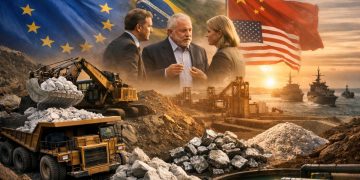








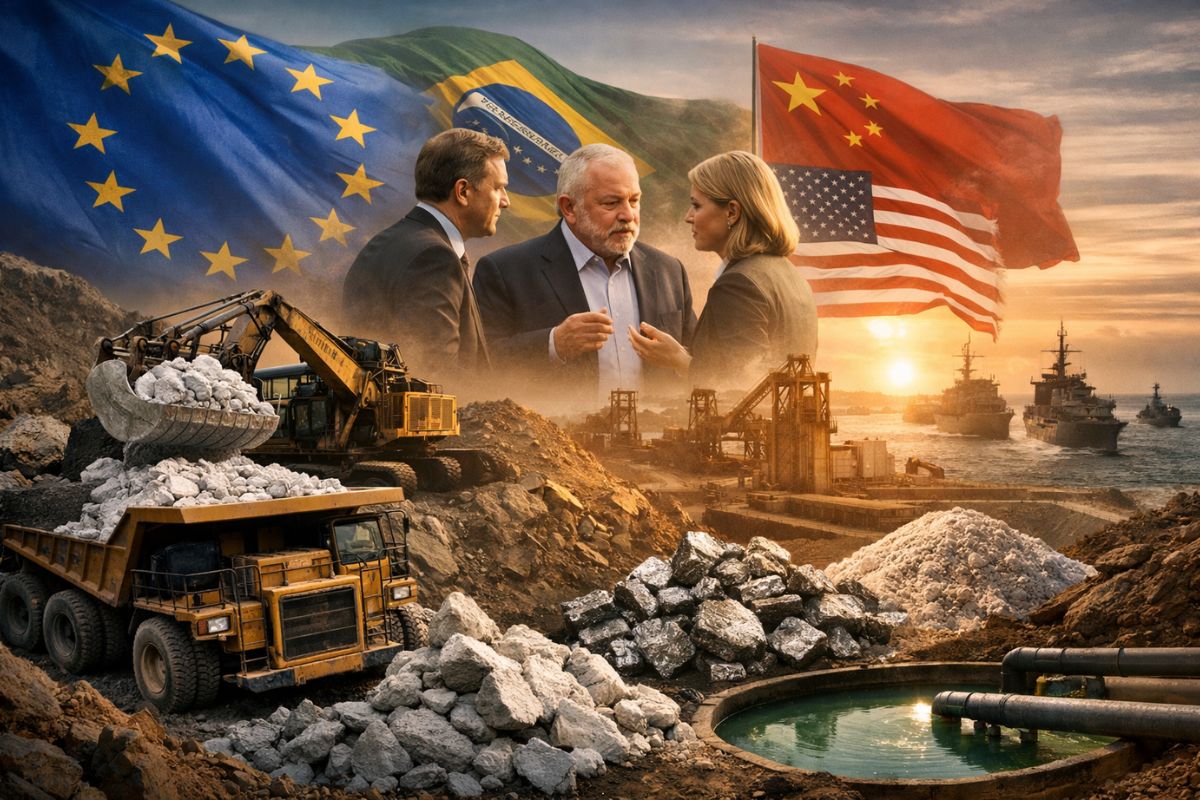
The European Union (EU) has formally entered the global race for Brazil’s strategic underground resources, opening negotiations with the government of President Luiz Inácio Lula da Silva on cooperation in rare earth elements, lithium, and nickel. The talks place Brazil at the center of an intensifying geopolitical contest involving Europe, the United States, and China.
During meetings in Rio de Janeiro, the European Commission confirmed that discussions are underway on a strategic minerals partnership focused on joint investments to support the energy transition, digital transformation, and strategic autonomy. The initiative elevates Brazil’s role as a key supplier of critical raw materials at a time when global supply chains are being reshaped.
Standing alongside President Lula, European Commission President Ursula von der Leyen stated that rare earth elements will become a cornerstone of the EU–Brazil relationship. The announcement was made in parallel with the political conclusion of the Mercosur–European Union trade agreement, a separate framework negotiated over 25 years and broader in scope than mineral cooperation.
Critical Minerals at the Core of Strategic Autonomy
The EU’s move signals a clear prioritization of critical raw materials, with cooperation on lithium, nickel, and rare earth elements expected to define future engagement between both sides. These materials are viewed as indispensable for clean energy systems, digital technologies, and defense-related industries.
Von der Leyen framed the negotiations as essential to Europe’s long-term objectives, linking access to critical minerals with the bloc’s energy transition, digital competitiveness, and strategic independence. In a global environment where minerals can become tools of economic and political leverage, supply diversification has become a strategic imperative.
Although the mineral talks unfolded alongside the Mercosur–EU agreement ceremony, both sides emphasized that the negotiations are distinct. While the trade agreement covers a wide range of goods and regulatory issues, discussions on rare earths and other critical minerals focus specifically on investment, industrial cooperation, and supply security.
Growing Competition from the United States and China
The EU’s entry into Brazil’s critical minerals landscape comes as the United States is also increasing its attention to Brazil’s strategic resources. As Western economies seek alternatives to existing supply concentrations, Brazil is emerging as a pivotal partner in efforts to reduce dependence on dominant producers.
Rare earth elements—comprising 17 chemical elements essential for wind turbines, electric vehicles, semiconductors, medical equipment, and military systems—sit at the intersection of energy, industry, and national security. Their strategic importance has intensified as global supply chains remain highly concentrated.
Processing and Value Creation Remain the Key Issue
Brazil holds the second-largest rare earth reserves in the world, behind only China. However, much of its production is still exported in raw or minimally processed form, limiting domestic value creation.
This reality reshapes the nature of negotiations. Beyond access to mineral reserves, discussions increasingly center on where processing and refining take place, who controls key industrial stages, and how much technological and economic value remains within Brazil.
While China continues to dominate refining and downstream processing, both the EU and the United States are seeking to diversify supply sources and build alternative value chains. In this context, Brazilian rare earths—and associated minerals such as nickel and lithium—are gaining strategic prominence as part of a broader reconfiguration of global industrial supply networks.
By describing the Mercosur–EU agreement as a “win-win” partnership and closing her remarks in Portuguese, von der Leyen underscored the political symbolism of closer ties, while clearly positioning critical minerals as a defining element of future cooperation.
As competition intensifies, Brazil finds itself at the center of overlapping global interests—where investment flows, industrial strategy, and geopolitical influence converge around minerals considered vital to the world’s economic and technological future.
The key question remains: should Brazil prioritize rapid foreign investment, or focus on ensuring domestic processing and higher value-added production within its borders?
———–
This article was written by Maria Heloisa Barbosa Borges, the original article can be found: https://en.clickpetroleoegas.com.br/The-European-Union-enters-the-global-race-for-Brazil%27s-subsoil-riches-and-negotiates-a-strategic-agreement-on-rare-earth-elements-with-the-Lula-government.-mhbb01/